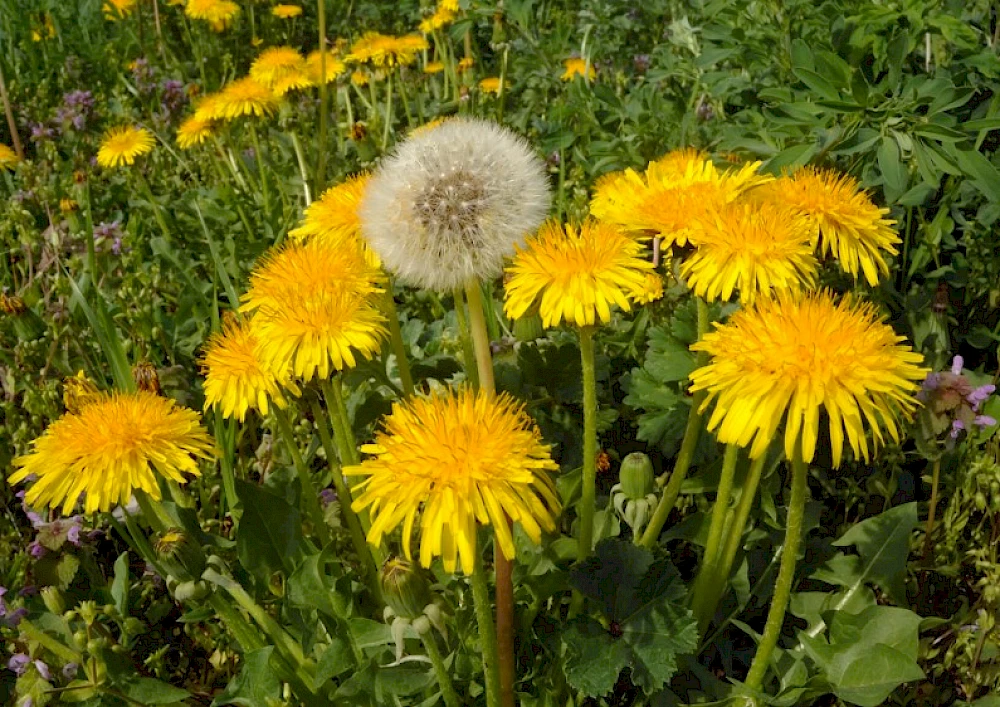
🌿 Dandelion
Löwenzahn
Taraxacum officinale F.H. Wigg.
Dandelion is a perennial herb belonging to the Asteraceae family. The plant develops a strong taproot and a basal rosette of leaves. Its yellow flower heads are carried on hollow, leafless stems. After flowering, the familiar parachute-like seeds are dispersed by the wind.
Dandelion is used both as a wild vegetable and as a traditional medicinal plant. The leaves and young plant parts are consumed as food, while the root is traditionally used particularly for digestive complaints, loss of appetite and to support urinary elimination. The plant contains bitter compounds, inulin, phenolic acids, flavonoids, carotenoids, triterpenes and other secondary plant compounds. Scientific studies describe antioxidant, anti-inflammatory, antimicrobial, hepatoprotective and other biological activities.
Dandelion is used both as a wild vegetable and as a traditional medicinal plant. The leaves and young plant parts are consumed as food, while the root is traditionally used particularly for digestive complaints, loss of appetite and to support urinary elimination. The plant contains bitter compounds, inulin, phenolic acids, flavonoids, carotenoids, triterpenes and other secondary plant compounds. Scientific studies describe antioxidant, anti-inflammatory, antimicrobial, hepatoprotective and other biological activities.
Notes
Leaves, flowers and roots can generally be used as food. Young leaves are commonly eaten raw in salads or cooked as a vegetable. The root can be dried, roasted and used, for example, as a coffee substitute.
The traditional use of dandelion is particularly documented for loss of appetite and gastrointestinal and urinary complaints. The EMA has herbal monographs for both dandelion root and dandelion leaf.
People with gallstones or bile duct obstruction should not use dandelion medicinally without medical advice. Caution is also appropriate in people with known allergies to plants of the Asteraceae family.
The traditional use of dandelion is particularly documented for loss of appetite and gastrointestinal and urinary complaints. The EMA has herbal monographs for both dandelion root and dandelion leaf.
People with gallstones or bile duct obstruction should not use dandelion medicinally without medical advice. Caution is also appropriate in people with known allergies to plants of the Asteraceae family.
Effects
- laxative
- antibacterial
- antimicrobial
- antioxidant
- appetite-stimulating
- anti-inflammatory
- choleretic
- diuretic
- urinary tract-supportive
- hepatoprotective
- nutrient-rich
- cytotoxic
- antiproliferative
Conditions
- loss of appetite
- bacterial infections
- bloating
- intestinal health
- type 2 diabetes
- inflammatory processes
- elevated blood glucose
- fatty liver
- joint complaints
- urinary tract complaints
- skin problems
- infections
- stomach complaints
- oxidative stress
- digestive complaints
- constipation
- feeling of fullness
- oedema
Application Areas
- general wellbeing
- urinary system
- bladder
- blood glucose regulation
- digestive system
- gallbladder
- biliary system
- urinary tract
- skin
- immune system
- liver and natural detoxification processes
- gastrointestinal system
- kidneys
- metabolism
- digestion
- cells
Plant Parts
- juice
- root
- leaf
- flower
- herb
Preparations
- decoction
- tincture
- tea
- raw
- powder
- dried
- ground
- cooked
- steamed
- freshly pressed juice
- extract
- infusion
Contraindications
- allergy or hypersensitivity to Asteraceae
- breastfeeding
- pregnancy
- kidney disease
- liver disease
- bile duct obstruction
- gallstones