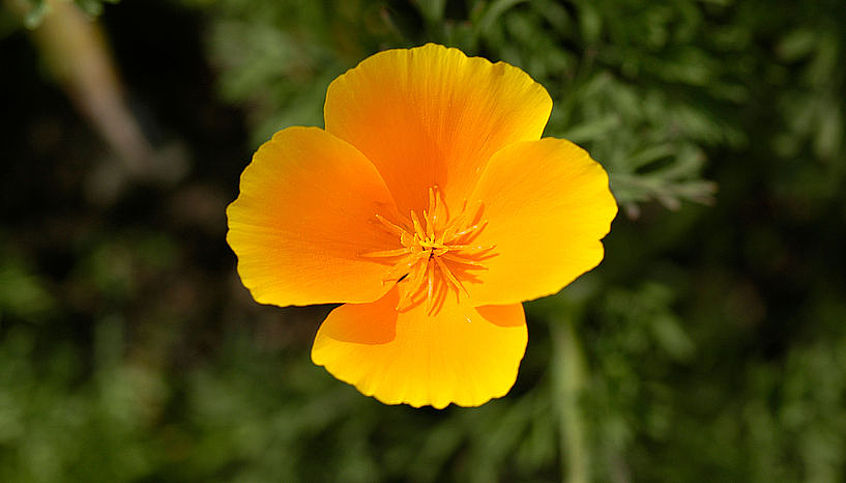
🌿 California poppy
Goldmohn
Eschscholzia californica Cham.
California poppy (Eschscholzia californica Cham.) is an annual to short-lived perennial herbaceous plant belonging to the poppy family (Papaveraceae). It is native to western North America and is particularly widespread in California, where it grows in sunny meadows, dry hillsides, open grasslands and along roadsides. It is also widely cultivated as an ornamental plant in Europe.
The plant typically reaches a height of approximately 20 to 50 centimetres. Its distinctive features include finely divided, bluish-green leaves and striking golden-yellow to orange flowers with four silky petals. The flowers open in sunlight and close during darkness or unfavourable weather conditions. Elongated seed capsules develop after flowering.
California poppy contains several isoquinoline alkaloids, including protopine, allocryptopine and californidine. Other constituents include flavonoids and various secondary plant compounds.
The flowering aerial parts have traditionally been used to promote relaxation and relieve nervous restlessness and mild sleep disturbances. Unlike opium poppy, California poppy does not have comparable morphine-related effects. Its potential calming and sleep-promoting properties are mainly associated with its alkaloid constituents.
Notes
California poppy has traditionally been used as a mildly calming herbal remedy for nervous restlessness, tension and minor sleep disturbances. The European Medicines Agency (EMA) recognises the traditional use of certain herbal preparations for relieving mild symptoms of mental stress and supporting sleep. This classification is based on longstanding use rather than sufficient evidence from clinical trials.
Other historical applications for pain, cramps, bedwetting or toothache should not be interpreted as evidence of established medical effectiveness. Antidepressant effects have not been adequately demonstrated in clinical studies.
Potential adverse effects and interactions have not been comprehensively investigated. Particular caution is advisable when combining California poppy with sedatives, sleeping medications or other centrally acting medicines. Use during pregnancy and breastfeeding is not recommended because of insufficient safety data. The relevant European herbal monograph also does not recommend use in children and adolescents under 18 years of age.
Persistent sleep problems, significant anxiety or depressive symptoms require medical assessment. California poppy should not replace prescribed medical treatment.
Effects
- anaesthetic
- diaphoretic
- pain-relieving
- sleep-promoting
- antispasmodic
- diuretic
- calming
- balancing
- antidepressant
- anxiolytic
Conditions
- toothache
- restlessness
- pain
- sleep disorders
- insomnia
- Incontinence
- Difficulty falling asleep
- bedwetting
Application Areas
- sleep and relaxation
- nervous system
Plant Parts
- juice
- aerial parts
Preparations
- tincture
- tea
- extract
Contraindications
- breastfeeding
- pregnancy